
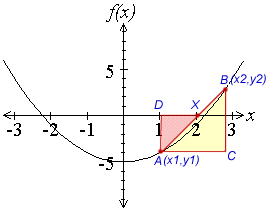
 The method of linear interpolation is also known as the method of false position. To find an approximate solution to the equation f(x)=0, start by
choosing values for x_1 and x_2. For the method to work, these values need to be
either side of the required root (marked X in the diagram); in other words
y_1 and y_2 need to be of
opposite sign. The possible solution is then calculated by assuming that the
curve is straight between (x_1, y_1) and
(x_2,y_2) (hence the term linear
interpolation) and using the similar triangles ABC and XAD to find the
position of X.
The method of linear interpolation is also known as the method of false position. To find an approximate solution to the equation f(x)=0, start by
choosing values for x_1 and x_2. For the method to work, these values need to be
either side of the required root (marked X in the diagram); in other words
y_1 and y_2 need to be of
opposite sign. The possible solution is then calculated by assuming that the
curve is straight between (x_1, y_1) and
(x_2,y_2) (hence the term linear
interpolation) and using the similar triangles ABC and XAD to find the
position of X. Because ABC and XAD are similar,
\displaystyle \frac{BC}{AC} = \frac{AD}{DX}, so
\displaystyle \frac{(y_2-y_1)}{(x_2-x_1)} = \frac{-y_1}{DX},
Our estimated solution is the x-coordinate of point X, ie., x_1 + DX, therefore
x = x_1 - \displaystyle \frac{y_1(x_2-x_1)}{(y_2-y_1)}
Summary/Background
The values you choose for x_1and x_2 need to be in the neighbourhood of the required solution. This means they need to be close enough so that they are not near other roots of the same equation.
Note the similarity between the formula above for linear interpolation, based on similar triangles:
x = x_1 - \displaystyle \frac{y_1(x_2-x_1)}{(y_2-y_1)}
and the formula for the Newton-Raphson method, based on gradient:
x_{n+1} = x_n - \displaystyle \frac{f(x_n)}{f'(x_n)}
The false position method uses the same formula as the secant method. However, the secant method does not require that the root remain bracketed like the bisection method does, and hence it does not always converge. However, it does not apply the formula on x_{n−1} and x_n, like the secant method, but on x_n and on the last iterate x_k such that f(x_k) and f(x_n) have a different sign. This means that the false position method always converges.
Note the similarity between the formula above for linear interpolation, based on similar triangles:
x = x_1 - \displaystyle \frac{y_1(x_2-x_1)}{(y_2-y_1)}
and the formula for the Newton-Raphson method, based on gradient:
x_{n+1} = x_n - \displaystyle \frac{f(x_n)}{f'(x_n)}
The false position method uses the same formula as the secant method. However, the secant method does not require that the root remain bracketed like the bisection method does, and hence it does not always converge. However, it does not apply the formula on x_{n−1} and x_n, like the secant method, but on x_n and on the last iterate x_k such that f(x_k) and f(x_n) have a different sign. This means that the false position method always converges.
Software/Applets used on this page

This applet forms part of "Java Number Cruncher: The Java Programmer's Guide to Numerical Computation", Prentice-Hall, by Ronald Mak, and is provided for MathsNetAlevel-plus by that author - see
Apropos-logic
Apropos-logic
This question appears in the following syllabi:
| Syllabus | Module | Section | Topic | Exam Year |
|---|---|---|---|---|
| AQA A-Level (UK - Pre-2017) | FP1 | Numerical Methods | Linear interpolation | - |
| AQA A2 Further Maths 2017 | Pure Maths | Numerical Methods | Linear Interpolation - Extra | - |
| AQA AS/A2 Further Maths 2017 | Pure Maths | Numerical Methods | Linear Interpolation - Extra | - |
| CCEA A-Level (NI) | C3 | Numerical Methods | Linear interpolation | - |
| Edexcel A-Level (UK - Pre-2017) | FP1 | Numerical Methods | Linear interpolation | - |
| Edexcel AS Further Maths 2017 | Further Pure 1 | Numerical Methods | Linear Interpolation | - |
| Edexcel AS/A2 Further Maths 2017 | Further Pure 1 | Numerical Methods | Linear Interpolation | - |
| Methods (UK) | M2 | Numerical Methods | Linear interpolation | - |
| OCR A-Level (UK - Pre-2017) | FP2 | Numerical Methods | Linear interpolation | - |
| OCR AS Further Maths 2017 | Pure Core | Numerical Methods - Extra | Linear Interpolation | - |
| OCR MEI AS Further Maths 2017 | Numerical Methods | Solution of Equations | Linear Interpolation | - |
| OCR-MEI A-Level (UK - Pre-2017) | NM | Numerical Methods | Linear interpolation | - |
| Universal (all site questions) | N | Numerical Methods | Linear interpolation | - |
| WJEC A-Level (Wales) | FP3 | Numerical Methods | Linear interpolation | - |